Views: 0 Author: Site Editor Publish Time: 2026-10-30 Origin: Site


The historical trade-off in clinical diagnostics has forced a difficult choice. Laboratories historically picked between the high sensitivity of central laboratory systems and the rapid turnaround time (TAT) of point-of-care (POC) devices. You no longer have to compromise. The emergence of miniaturized chemiluminescence immunoassay (CLIA) technology has completely disrupted this binary. It allows healthcare facilities to decentralize high-acuity testing without sacrificing analytical performance.
Delayed diagnostic results directly impact patient triage and discharge rates in critical care. This guide provides a clinical and operational framework to evaluate your best path forward. You will learn how to assess whether a decentralized POC approach, a centralized model, or a hybrid testing strategy best serves your facility. We explore patient flow, budget realities, and compliance requirements in detail.
Performance Parity: Modern POCT CLIA devices utilize the same fundamental reaction principles as central lab systems, offering comparable analytical sensitivity for critical assays (e.g., troponin, hormones).
Operational Trade-offs: Central lab systems win on high-volume throughput and cost-per-test at scale; POC CLIA systems win on single-sample TAT, reduced footprint, and lower infrastructure requirements.
Strategic Fit: POC CLIA is highly effective for primary hospitals, emergency departments, and urgent care centers, whereas central systems remain essential for core hospital reference labs processing hundreds of samples daily.
Delays in critical diagnostic results directly impact patient triage and discharge rates. Conditions like acute myocardial infarction or severe infectious diseases require immediate intervention. However, investing in rapid systems must align closely alongside actual daily testing volumes. Purchasing advanced equipment without assessing throughput needs often leads to operational inefficiencies.
Central laboratory realities center heavily around batch processing. TAT is bottlenecked by sample transport, centrifugation, and long queueing times. These necessary steps often take 60 to 120 minutes from draw to result. This delay creates massive bottlenecks in emergency departments during peak hours. You must account for transit delays when relying purely on centralized testing.
POCT CLIA realities offer a entirely different operational model. Manufacturers build them for on-demand, single-sample, or small-batch processing. They eliminate transport and preparation time almost entirely. You often receive actionable results in 15 to 20 minutes. This speed empowers clinicians to make immediate triage decisions.
When conducting a POCT CLIA analyzer comparison, assess your facility’s peak hour bottlenecks carefully. If your primary bottleneck is processing volume, lean toward central systems. If the bottleneck is clinical decision speed, lean toward decentralized POC solutions. Match the technology to your most pressing workflow constraint.
Historically, rapid lateral flow tests sacrificed clinical sensitivity for speed. Buyers must verify if a compact immunoassay POCT analyzer genuinely delivers central-lab-level precision. Skepticism remains highly justified when adopting smaller footprints for critical care. A false negative in cardiac triage carries catastrophic consequences for patient outcomes.
First, examine the underlying detection methodology thoroughly. Check whether the POC device uses true chemiluminescence identical to central platforms. It should employ robust magnetic particle separation and stable enzymatic triggers. Avoid systems relying on diluted or alternative reaction principles. These alternative methods often struggle at the lower end of the measurement range.
Next, evaluate the Limit of Detection (LoD). Also, check the dynamic range for high-sensitivity assays. Tests like highly sensitive troponin I (hs-cTnI) and Procalcitonin (PCT) demand extreme precision. Evidence-oriented procurement requires comparing the Coefficient of Variation (CV). You must compare this specific CV between the POC unit and your current core lab system. Acceptable variance depends on established clinical guidelines.
Finally, assess matrix compatibility carefully. Central systems handle serum, plasma, and urine effortlessly because they include centrifugation steps. Verify if the POC system accepts whole blood directly. Direct whole blood processing provides a critical operational advantage. It removes the need for sample prep in fast-paced emergency settings.
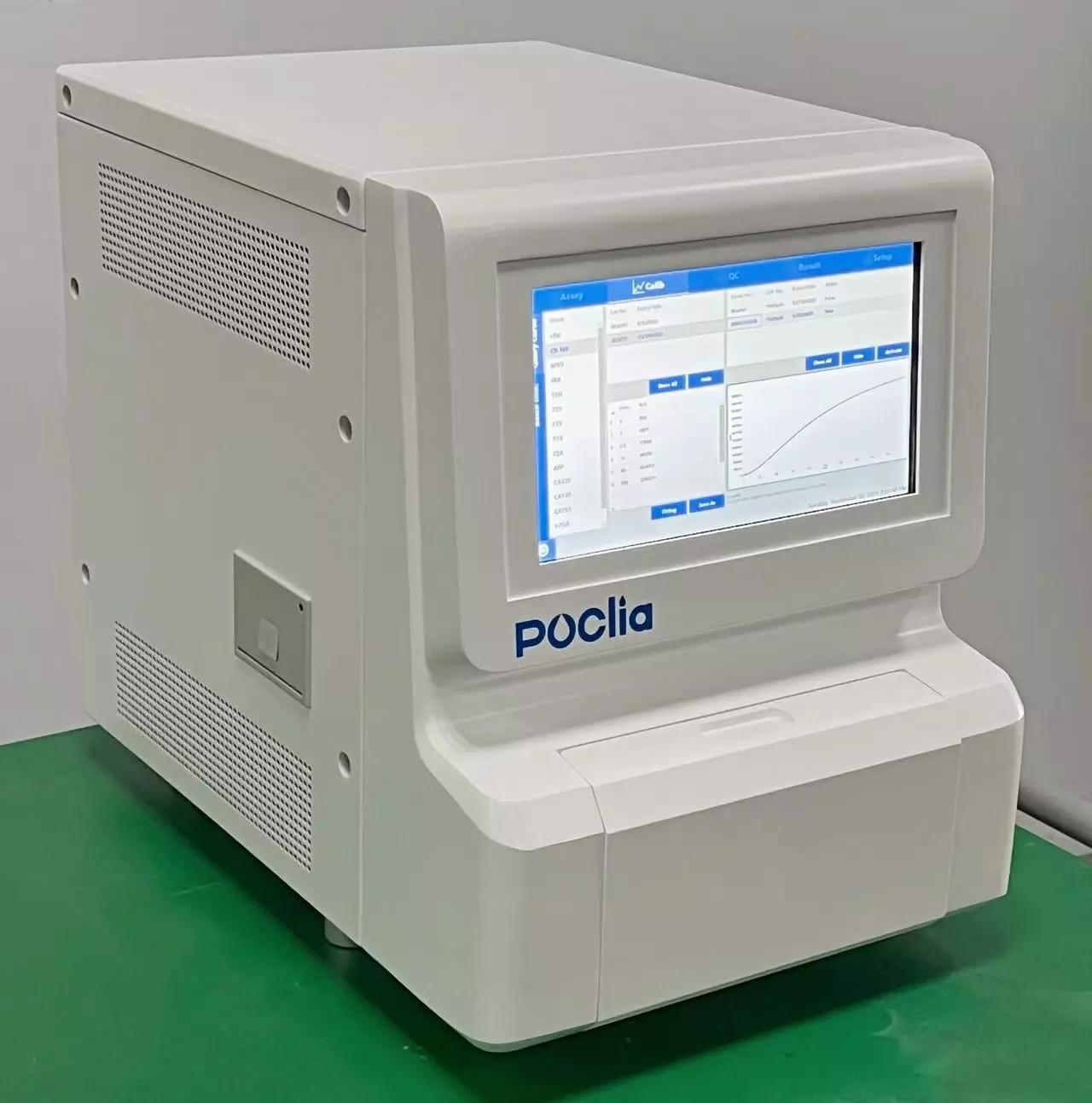
Central lab systems require dedicated floor space and strict climate control. They also demand complex water purification systems and reinforced infrastructure. In contrast, POC CLIA analyzers are benchtop-sized. They require a minimal footprint and use standard power outlets. This compact advantage transforms space utilization in crowded clinics.
Operator expertise varies drastically between these testing models. Central systems require certified medical laboratory scientists (MLS). These highly trained professionals manage daily operation, maintenance, and complex troubleshooting. Alternatively, manufacturers design POC systems specifically for non-laboratory personnel. Nurses and primary care staff can operate them easily after basic training.
To support non-lab operators, these devices feature pre-packaged, single-dose reagent cartridges. They also utilize automated calibration protocols. A major implementation risk involves user error by non-lab staff. You must evaluate the device for built-in error prevention features. Look for automated barcode scanning and an highly intuitive user interface.
Best Practices for Preventing POC User Errors:
Implement mandatory hands-on training sessions for all nursing staff.
Utilize automated lock-out features for uncertified operators.
Select devices featuring visual, step-by-step touchscreen prompts.
Operational Comparison: Central Lab vs. POCT CLIA Models
Feature | Central Laboratory System | POCT CLIA Analyzer |
|---|---|---|
Footprint | Floor-standing, requires dedicated room | Benchtop, highly portable |
Turnaround Time | 60–120 minutes | 15–20 minutes |
Primary Operator | Medical Laboratory Scientist (MLS) | Nurses, Medical Assistants |
Sample Type | Serum, Plasma (Requires Prep) | Whole Blood, Serum, Plasma |
Capital expenditure (CAPEX) differs wildly between centralized and decentralized models. Central lab systems require massive upfront financial investment. Alternatively, they trap facilities in restrictive long-term reagent rental agreements. These contracts mandate high minimum testing volumes. POC CLIA analyzers have a significantly lower entry cost. This affordability allows smaller primary hospitals to acquire advanced technology easily.
Operational expenditure (OPEX) and cost-per-test follow completely different curves. Central platforms offer a low cost-per-test only if running at high capacity. Reagents often arrive in bulk packaging. This bulk sizing leads to massive waste if daily volumes drop unexpectedly. You end up discarding expired materials frequently.
POC platforms typically show a higher absolute cost-per-test. However, they utilize single-use or small-batch packaging. This packaging entirely eliminates open-vial reagent waste for low-volume assays. You only pay for the exact tests you run. This financial predictability benefits urgent care centers with fluctuating patient volumes.
Common Mistake: Do not judge a system solely by its upfront hardware price. Always calculate the projected reagent waste percentages based on your specific daily patient census.
Navigating FDA classifications is mandatory during procurement. You must understand CLIA Waived versus Moderate or High Complexity categorizations. An immunoassay analyzer requiring moderate complexity compliance dictates specific staffing and QA protocols. You must ensure your facility meets these specific regulatory thresholds before purchasing.
Central labs have established, rigorous QC routines overseen by dedicated managers. Decentralized POC requires stringent, often automated, QC lock-outs. These features ensure compliance across multiple departments or primary hospital branches. They physically prevent untrained users from running patient samples without passing daily QC checks.
Data silo risks present a major integration challenge for decentralized fleets. A POC system becomes functionally useless if data fails to reach the electronic health record (EHR). Evaluate the device's connectivity standards, specifically HL7 and POCT1-A2. Assess the IT burden of integrating a decentralized fleet into your existing LIS. Seamless data transfer guarantees accurate billing and faster clinical responses.
Healthcare leaders need a clear framework to shortlist the right diagnostic system. Making the wrong choice leads to wasted capital and frustrated clinical staff. Review these distinct operational scenarios to guide your procurement strategy.
When to stick with Central Lab Systems:
You process consistent daily volumes exceeding 500 tests.
You have dedicated laboratory staff available 24/7 on-site.
Your testing demands massive assay menus exceeding 100 parameters.
When to adopt a POC CLIA analyzer:
Your emergency department needs stat cardiac or infection markers immediately.
Your primary hospital lacks core lab infrastructure or water purification systems.
Your outpatient clinic aims for single-visit diagnoses to improve patient satisfaction.
The hybrid approach offers an excellent middle ground for larger institutions. Implement hub-and-spoke models where central labs handle routine metabolic panels. Simultaneously, deploy specialized POC units in the ICU or ED for urgent needs. This strategy balances high-volume efficiency with critical care speed.
During vendor evaluation, request a head-to-head clinical concordance study. Split-sample testing provides undeniable proof of analytical accuracy. Run identical patient samples on both the prospective POC device and your established central analyzer.
The choice between decentralized and centralized testing is no longer a compromise between speed and accuracy. It is a strategic decision based on clinical workflow, throughput requirements, and infrastructure constraints. Modern miniaturized systems now deliver lab-quality precision directly to the patient bedside.
Healthcare administrators should map their exact patient pathways and TAT bottlenecks before engaging vendors. Understanding where your delays occur prevents reactionary purchasing. You must identify whether sample transport or analytical time causes the most friction.
Evaluate your current testing delays immediately. Request clinical performance data for the specific assays most critical to your facility's triage process. Conduct a thorough split-sample validation to secure clinical buy-in from your medical staff.
A: Most modern POC devices drastically reduce physical calibration requirements. They utilize factory master curves embedded in barcodes or RFID tags on the reagent cartridges. Operators typically run a simple two-point calibration every 14 to 30 days, or when opening a new lot. This minimizes the daily maintenance burden compared to central systems.
A: No. Central labs offer hundreds of testing parameters. POC menus are deliberately curated for acute and routine care. They typically feature 20 to 50 key assays, focusing heavily on cardiac markers, infectious diseases, hormones, and inflammatory proteins. They prioritize assays where immediate results alter patient care.
A: Facilities use dedicated POCT management software to maintain oversight. This software centralizes IT control over the entire fleet. It enforces automated QC lockouts if a device fails its daily check. This ensures strict compliance and standardizes performance across all hospital departments without requiring physical lab staff presence.
A: Most high-sensitivity CLIA systems fall under moderate complexity classifications. The intricate nature of chemiluminescence and necessary sample handling prevents a fully waived status. However, certain targeted devices or specific assays occasionally secure waivers. Always verify the exact FDA classification for your intended testing menu.


