Views: 0 Author: Site Editor Publish Time: 2026-10-14 Origin: Site


Point-of-care testing (POCT) brings vital diagnostic answers directly to the patient’s side in moments of critical need. However, selecting the right diagnostic equipment remains a high-stakes balancing act. Administrators must constantly weigh lab-grade analytical accuracy against the demand for rapid clinical workflow speed. Over-indexing on pure speed while ignoring robust data integration or regulatory compliance features often leads to severe workflow bottlenecks down the line. Such oversights introduce hidden regulatory vulnerabilities, delay patient triage, and create unexpected operational hurdles for clinical staff. For lab directors and clinic administrators evaluating a new immunoassay POCT analyzer, moving past glossy marketing brochures requires strict due diligence. You must systematically evaluate analytical capabilities, daily operational workflows, and overarching IT specifications. This rigorous approach ensures the chosen platform genuinely enhances patient care without compromising laboratory quality standards.
Analytical performance (sensitivity and precision) must align with your clinical decision limits; not all POCT devices match central lab standards.
Turnaround Time (TAT) and throughput must be evaluated alongside instrument footprint and workflow design (e.g., random access vs. batch testing).
Seamless bi-directional LIS/HIS connectivity (POCT1-A2 standard) is non-negotiable for billing compliance and data integrity.
The distinction between standard fluorescence immunoassays and a POC CLIA analyzer (Chemiluminescence) determines your facility's capability to handle highly sensitive cardiac or hormone panels.
Understanding the core technology driving your diagnostic device is the first step in technology procurement. Fluorescence Immunoassay (FIA) represents a widely adopted methodology suitable for routine biomarker screening. However, Chemiluminescence Immunoassay (CLIA) offers vastly superior signal-to-noise ratios. You must recognize exactly when clinical protocols require transitioning to a POC CLIA analyzer. Assays demanding extreme analytical sensitivity simply cannot rely on standard fluorescence. For example, ruling out myocardial infarction using high-sensitivity Troponin I or T (hs-cTn) requires detecting biomarkers at picogram levels. Only advanced chemiluminescence platforms achieve this rigorous detection threshold at the point of care.
Analytical precision directly impacts clinical confidence. You should always demand verifiable data regarding the Coefficient of Variation (CV). Review both intra-assay (within-run) and inter-assay (between-run) precision limits carefully. Acceptable CV percentages vary heavily by analyte, but they should tightly mirror the performance of central laboratory benchtop analyzers. Next, evaluate the measuring range. A broad dynamic range minimizes the need for manual sample dilutions. Manual dilution steps introduce technician error and delay critical results. A well-engineered device handles extreme high and low concentrations automatically.
Real-world clinical samples rarely present perfectly. You must review manufacturer data regarding common interferents to mitigate false results in acute care settings. Hemolysis, lipemia, and icterus routinely disrupt standard optical readings. Furthermore, biotin interference remains a massive vulnerability for many sandwich immunoassays. Many patients consume over-the-counter biotin supplements, which can falsely elevate or depress specific biomarker readings. Robust point-of-care platforms utilize proprietary blocking agents to neutralize these common interferents. Always ask vendors to provide peer-reviewed validation studies demonstrating their platform's robustness against these specific challenges.
Speed matters immensely in emergency medicine, but marketing brochures often misrepresent true turnaround times. You must evaluate the Time-to-First-Result (TTFR) rigorously. Measure this interval from the exact moment of sample insertion to the generation of a clinically actionable, printable result. Emergency departments and urgent care clinics depend entirely on rapid TTFR to accelerate patient discharge and admission rates. A machine advertising a five-minute test cycle holds little value if manual sample preparation requires ten additional minutes.
Examine how the device integrates into your daily nursing or technician workflow. Compare single-test modules against multi-test modules. Does the machine support continuous loading? True random access functionality allows staff to insert new patient samples continuously without interrupting ongoing tests. Conversely, batch testing locks the instrument down during a cycle, creating frustrating bottlenecks during peak admission hours. Additionally, evaluate sample type flexibility. Top-tier devices run whole blood natively. They utilize microfluidic filters to separate plasma internally, entirely eliminating the need for manual centrifugation prior to testing.
Decentralized testing environments rarely offer abundant counter space. You must assess the size-to-throughput ratio carefully. A compact layout is usually necessary for tight clinical spaces, triage bays, and mobile medical units. However, shrinking the physical footprint must not sacrifice essential hardware capabilities. High-performance devices require robust internal cooling systems to maintain onboard reagent stability. Without proper thermal management, ambient temperature fluctuations quickly degrade cartridge reliability.
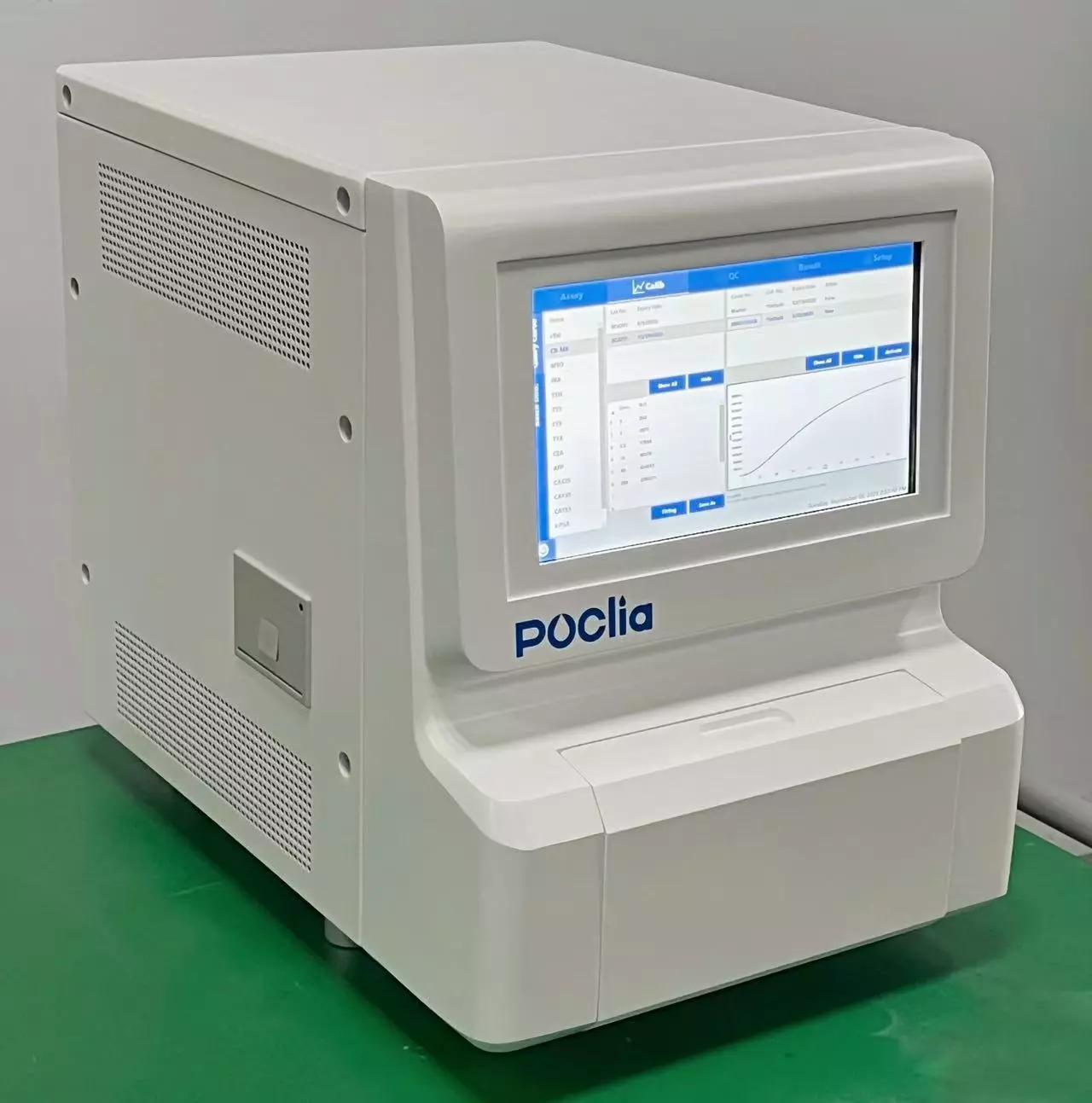
A diagnostic instrument is only as valuable as its test menu. Evaluate the currently available breadth of assays to ensure they meet your daily clinical demands. Standard panels typically include cardiac markers (Troponin, BNP, D-Dimer), infectious disease antigens, hormones, and coagulation parameters. However, evaluating current capabilities is only half the equation. You must assess the manufacturer's development pipeline. Look closely for pending FDA-cleared or CE-marked assays. Investing in a platform featuring a robust, active pipeline ensures your hardware will not become clinically obsolete within a few years.
Consumable logistics dictate the hidden operational burden of any POCT program. Compare room-temperature stable reagents against those requiring refrigerated storage. Cold-chain storage complicates clinical workflows significantly. Staff must monitor refrigerator temperatures daily and allow cartridges to reach room temperature before use. This waiting period negates the primary speed advantage of point-of-care testing. Review the onboard stability specifications carefully to understand how long opened reagents remain viable inside the machine.
Consider the physical format of the testing consumables. Single-use cartridges process one patient sample at a time. They eliminate chemical waste and require zero fluidic maintenance. Low-volume clinics benefit immensely from this design, despite a slightly higher cost per test. Alternatively, bulk reagent systems suit high-throughput emergency departments better. We summarize these operational trade-offs below to help guide your procurement strategy.
Table 1: Comparison of Reagent Delivery Formats
Feature | Single-Use Cartridges | Bulk Reagent Systems |
|---|---|---|
Target Environment | Low-to-medium volume clinics | High-throughput EDs and core labs |
Waste Profile | Minimal liquid waste; solid waste only | Requires dedicated liquid waste management |
Maintenance Needs | Virtually zero fluidic maintenance | Requires routine line flushing and cleaning |
Onboard Stability | Sealed until the moment of testing | Requires advanced internal cooling systems |
Modern healthcare environments cannot tolerate isolated data silos. Seamless bidirectional connectivity remains absolutely non-negotiable. Look for devices offering native HL7 communication protocols and strict adherence to the POCT1-A2 standard. Bidirectional communication fundamentally streamlines clinical operations. It allows the instrument to download pending patient orders directly from the Electronic Health Record (EHR). Once the assay completes, the device automatically uploads verified results back to the patient's file. This prevents manual transcription errors and ensures accurate billing capture.
Networked medical devices present significant cybersecurity vulnerabilities. You must prioritize patient data protection during the evaluation phase. Data encryption standards must meet current hospital IT benchmarks. User authentication requirements, such as unique operator IDs and password expirations, prevent unauthorized access to clinical data. Secure audit trails track every action performed on the device, ensuring strict compliance with HIPAA and GDPR regulations. A modern immunoassay POCT analyzer should safeguard sensitive patient demographics autonomously without requiring constant IT intervention.
Data routing rarely happens directly between the analyzer and the EHR. Evaluate whether the platform requires expensive, proprietary middleware to function on your network. Some manufacturers lock you into their specific software ecosystems. Others build their systems to integrate smoothly with agnostic hospital IT infrastructures. Opting for open architecture reduces long-term operational friction. It empowers your IT department to manage device fleets across multiple physical locations using centralized dashboard solutions.
Point-of-care devices are frequently operated by nursing staff, not specialized laboratory technicians. Therefore, complex user interfaces introduce severe training burdens and increase the risk of operational errors. Evaluate touchscreen intuitiveness meticulously. The software should guide the user step-by-step through the testing protocol. Built-in barcode scanning for patient ID bracelets prevents dangerous sample mix-ups. Furthermore, seek out systems featuring automated lot calibration. Devices using RFID tags or QR codes to read reagent lot data eliminate manual entry errors entirely.
Quality Control automation separates average devices from clinical-grade platforms. QC lockouts represent an essential compliance specification for any accredited facility. The machine must possess the capability to automatically lock operators out if daily or weekly QC fails. It must also restrict testing if the current QC interval expires. You should also evaluate the frequency of mandatory calibration. Systems requiring highly frequent recalibrations cause unacceptable operational downtime and frustrate clinical staff during busy shifts.
A device's regulatory status heavily influences staffing requirements. Understand the practical distinction between CLIA-waived and moderately complex categorization. CLIA-waived devices utilize highly simplified testing mechanisms. They dramatically reduce personnel credentialing requirements, making them ideal for decentralized clinics and pharmacies. Moderately complex devices, while often more capable, require strict laboratory director supervision, rigorous proficiency testing, and specific operator educational credentials. Choose the regulatory tier aligning with your facility's staffing realities.
Evaluating a clinical vendor requires looking far beyond the initial hardware specifications. Service and support agreements protect your daily diagnostic operations from catastrophic downtime. Scrutinize the vendor's Service Level Agreements (SLAs) closely. Review standard warranty terms for transparency regarding parts and labor coverage. Demand guaranteed replacement times for defective units; many top-tier vendors offer next-day overnight shipping for replacement analyzers. Furthermore, prioritize devices featuring remote diagnostic capabilities. This technology allows vendor support teams to securely access the instrument's error logs and troubleshoot software issues instantly, bypassing the need for physical service visits.
Establish a disciplined procurement framework before soliciting vendor proposals. Follow these crucial steps to ensure a successful implementation:
Define Your Non-Negotiables: Document mandatory requirements clearly. Determine if the device absolutely must be CLIA-waived, if it must perform high-sensitivity cardiac troponin testing, and if it requires POCT1-A2 integration.
Engage Stakeholders Early: Consult your internal Point-of-Care Coordinator and network IT security team to map out physical and digital integration requirements.
Request In-Clinic Demonstrations: Never purchase equipment based on brochures alone. Demand a hands-on demonstration using real clinical sample matrices.
Execute Correlation Studies: Run a pilot correlation study comparing the POCT analyzer's results against your central laboratory's primary benchtop analyzer. Ensure the statistical variance remains within clinically acceptable limits.
Procuring a decentralized diagnostic system transforms clinical operations entirely. You are not merely purchasing laboratory hardware; you are actively integrating a completely new workflow into your patient care pathway. Your final decision must prioritize clinical necessity over generic feature lists. Urgent care centers might prioritize CLIA-waived menus and rapid throughput to handle seasonal volumes. Conversely, emergency departments must prioritize extreme analytical sensitivity and rigorous IT integration to manage acute cardiac pathways.
Take decisive action by consulting your internal stakeholders immediately. Align your clinical objectives, IT security requirements, and operational workflows before inviting vendors to the table. By executing a strict evaluation of analytical capabilities, workflow dynamics, and compliance features, you ensure the selected platform delivers reliable, lab-grade results directly to the patient's bedside.
A: Standard lateral flow tests offer rapid results but lack extreme analytical sensitivity. A POC CLIA analyzer uses advanced chemiluminescence technology to amplify biomarker signals. It reliably detects molecules at much lower concentrations, often reaching picogram levels instead of nanograms. This extreme sensitivity proves crucial for critical diagnostics like high-sensitivity troponin assays.
A: The POCT1-A2 standard ensures plug-and-play, bidirectional data flow between the device and your hospital networks. Devices supporting this standard seamlessly download patient orders and automatically upload verified results. This automated communication prevents manual transcription errors, guarantees accurate billing capture, and populates the electronic health record instantly without staff intervention.
A: Yes, many top-tier decentralized models process whole blood directly. They utilize internal microfluidics or built-in filtration mechanisms inside the cartridges. These internal structures separate plasma from red blood cells automatically during the testing cycle. This smart engineering eliminates the need for a centrifuge at the point of care, accelerating overall turnaround times.


