Views: 0 Author: Site Editor Publish Time: 2026-08-02 Origin: Site


The gap between a compromised assay and highly reproducible data frequently hides in the washing step. Detection instruments often grab the spotlight during procurement discussions. However, incomplete washing remains the primary culprit for high background noise and poor intra-plate variation. A microplate washer is a high-frequency, mechanically intense device. It handles corrosive buffers and operates under constant physical stress. Purchasing decisions must balance delicate fluidic precision alongside long-term mechanical reliability. When laboratories neglect washer performance, they risk sacrificing critical assay sensitivity. You cannot fix poor washing with superior detection software. This guide provides a definitive framework for evaluating, shortlisting, and procuring the right automated system. We will show you how to assess strict performance metrics objectively. You will learn to match assay-specific requirements carefully. We will also help you verify operational durability before buying. Read on to master these critical procurement parameters.
The Gold Standard for Residuals: High-fidelity equipment must guarantee a residual volume of ≤2μL per well to ensure reliable signal-to-noise ratios.
Assay-Specific Fluidics: Standard ELISA requires rigorous mechanical washing, whereas cell-based assays mandate angled, low-flow dispensing to protect adherent monolayers.
Hardware Integration: Modern workflows require seamless data and physical integration between your microplate reader washer setups and existing Laboratory Information Systems (LIS).
Hidden Lifecycle Costs: Because washers experience significantly more mechanical wear than plate readers, features like ultrasonic self-cleaning and robust service warranties are critical ROI factors.
Transitioning from manual multichannel pipetting to an automated laboratory plate washer eliminates user-to-user variation completely. It also reduces processing time by up to 90%. Manual washing introduces inconsistent dispense forces across different plate columns. These human variations heavily impact data accuracy. Pipetting fatigue frequently leads to varied aspiration angles. This leaves uneven residual volumes behind.
You must identify existing washer failures early. Watch out for these common diagnostic signs in your data:
High overall background: This usually points to insufficient soak times. It can also indicate weak aspiration power leaving unbound proteins behind.
High Coefficient of Variation (CV) between wells: This typically indicates clogged manifold tubes. Uneven dispensing pressure causes severe precision issues across the entire plate.
Establish a firm decision threshold for your lab. If your current setup cannot consistently maintain an operational well-to-well CV of <3% and a whole-plate CV of <4%, it is time to evaluate new hardware. Continuing to use degraded equipment compromises assay integrity. Upgrading your equipment pays for itself by reducing failed assay reruns.
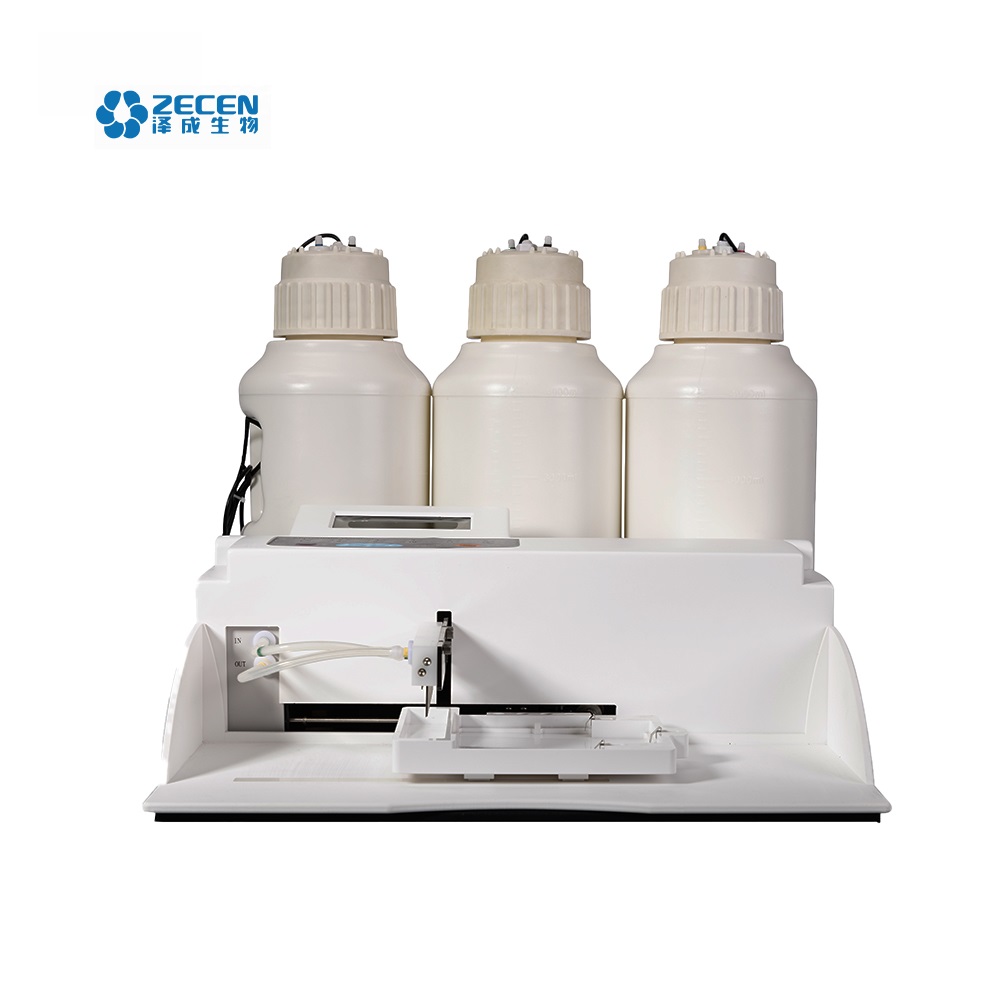
Achieving low residue plate washing is the paramount metric during evaluation. You must shortlist only machines proven to leave ≤2μL of residual fluid per well. Higher residual volumes dilute subsequent reagents unpredictably. They drastically reduce your assay signal window. Excessive fluid left behind also causes optical interference during the reading phase.
Evaluate the aspiration technology strictly. We recommend reviewing these core technical features:
Dual-Point Suction & Bottom Flushing: Look for machines featuring sweeping or crosswise aspiration patterns. This minimizes micro-pooling at the well edges. It captures liquid clinging to the side walls efficiently.
Probe Depth Calibration: Systems must allow sub-millimeter adjustment of probe height. This prevents scratching the well bottom. It maximizes fluid removal safely without damaging coated antigens.
Manifold design dictates long-term usability. Opt for equipment offering separated dispense and aspirate manifolds. This configuration allows for safe overfill washing. It prevents fluid backing up into the internal pump system. Configuration flexibility also matters immensely. Ensure the availability of modular wash heads. You might need 8-channel modules or a specialized 12-well microplate washer manifold. Modular designs accommodate both standard 96-well formats and high-throughput 384-well plates seamlessly. Adapting to future plate formats protects your initial investment.
Performance Metric | Standard Baseline | High-Fidelity Goal |
|---|---|---|
Residual Volume | ≤5μL per well | ≤2μL per well |
Well-to-Well CV | <5% | <3% |
Whole-Plate CV | <7% | <4% |
Different biological applications demand specific fluidic handling. Standard biochemical ELISAs require robust fluid dynamics. An ideal ELISA washer should support highly programmable soak times. You typically need 30 to 60 seconds for stubborn non-specific binding. Detergents like Tween 20 require adequate time to break protein interactions. You must easily configure wash cycles. Optimally, run 3 to 5 cycles. Exceeding 5 yields diminishing returns. It also increases error risk by potentially stripping specific antibodies.
Adherent cell-based assays present unique challenges. Cell monolayers easily dislodge under direct fluid pressure. Evaluate washers offering angled dispensing capabilities. The fluid should cascade gently down the well wall. You also need precise low-flow rate adjustments to protect delicate cells during processing.
Magnetic bead assays require specialized hardware setups. If you process multiplex or bead-based assays, verify magnet compatibility. The washer must accept flat or ring-magnet carriers. These carriers secure beads safely during the aspiration phase. Ring magnets pull beads to the side, allowing the probe to enter the center safely without aspirating your samples.
Assay Type | Dispense Style | Flow Rate Category | Typical Cycle Count |
|---|---|---|---|
Standard ELISA | Direct bottom delivery | High / Vigorous | 3 to 5 cycles |
Adherent Cells | Angled side-wall cascade | Low / Gentle | 1 to 3 cycles |
Magnetic Beads | Direct bottom delivery | Medium / Controlled | 2 to 4 cycles |
Readers and washers should ideally share compatible software environments. A unified microplate reader washer setup simplifies your validation process. It standardizes assay protocols rapidly across your entire laboratory. Such synergy also accelerates Laboratory Information System (LIS) data integration. Unified software reduces the training burden on new technicians significantly.
For scaling laboratories, assess the physical footprint carefully. Check API availability for robotic arm plate handlers. Compatibility with automated incubators ensures true walk-away operational freedom. High-throughput labs depend on reliable physical hand-offs between separate devices.
Best Practice: Always request vendor documentation detailing LIS communication protocols before finalizing your purchase. Open-source API options provide greater long-term flexibility.
Clinical or regulated labs require strict software compliance. You must verify onboard interface capabilities carefully. Ensure the system fully supports 21 CFR Part 11 compliance. This includes comprehensive digital audit trails. It must also offer granular user access levels. You need password protection to prevent unauthorized protocol modifications.
Washers utilize complex pumps, valves, and moving manifolds. Their mechanical degradation rate runs significantly higher than optical readers. You must prioritize hardware durability. Moving parts wear out faster under high-throughput conditions.
Crystallized salts from buffers like PBS or TBS cause severe problems. Proteins also build up over time within the narrow tubes. These elements are the primary cause of downtime. Prioritize washers featuring built-in clog prevention technologies. Ultrasonic Advantage offers onboard ultrasonic baths for the manifold. Automated anti-clogging verification routines ensure consistent performance. They detect blockages before an entire plate is ruined.
Common Mistake: Neglecting daily flush routines leads directly to irreversible manifold blockages. You cannot recover severely calcified tubes easily.
Ensure the system allows for easy daily flushing routines. It should support weekly acid-wash cycles automatically. You should not require an on-site technician for routine cleaning. User-serviceable parts reduce operational friction immensely.
Evaluate the vendor Service Level Agreement (SLA) closely. Next-day replacement parts are critical. Local technician availability should heavily influence the final purchasing decision. Extended downtime delays critical research timelines and wastes expensive reagents.
Selecting the right microplate washer is not just about throughput speed. It is a vital exercise in assay risk mitigation. You must prioritize certified residual volumes below 2μL. Look for separated fluidic manifolds to protect internal systems. Choose automated maintenance features over superficial software add-ons.
Take these action-oriented next steps for your procurement journey:
Request a physical wet-run demo from your shortlisted vendors.
Test the equipment using your specific wash buffers, especially those containing 0.05% Tween 20.
Run a standardized dye-dilution test to physically verify aspiration uniformity across all channels.
Review the service warranty terms before issuing a purchase order.
A: Industry standards dictate that high-fidelity washers should leave ≤2μL of fluid per well in a 96-well format. Values above 5μL will significantly compromise assay sensitivity. Excessive residuals dilute subsequent reagents and reduce the overall signal-to-noise ratio.
A: Utilize a washer equipped with adjustable, low-velocity dispense rates and angled fluid delivery. The fluid should cascade down the side of the well rather than impacting the bottom directly. This gentle fluidic action protects fragile cell monolayers.
A: Only up to a point. Standard protocols recommend 3 to 5 wash cycles. Adding more than 5 cycles rarely improves signal-to-noise ratios. It often risks desorbing the specific antigen-antibody complexes, which ultimately lowers the overall assay signal.
A: Daily automated flushing with deionized water is mandatory to prevent buffer salt crystallization. Deep cleaning of the aspiration probes should be performed weekly. You can use an acid wash or ultrasonic cleaning to ensure consistent well-to-well CVs.


